
NX
TMG Electronic Systems Cooling
for  Advanced Simulation environment is an industry-specific vertical application
that leverages the NX
Flow
and NX
Thermal
solvers as well as the PCB.xchange and other high tech and electronics
industry-specific cooling capabilities in a bundle product. It provides a
comprehensive set of tools to simulate 3D air flow and thermo-fluid behaviour in
high tech and electronic systems.
Advanced Simulation environment is an industry-specific vertical application
that leverages the NX
Flow
and NX
Thermal
solvers as well as the PCB.xchange and other high tech and electronics
industry-specific cooling capabilities in a bundle product. It provides a
comprehensive set of tools to simulate 3D air flow and thermo-fluid behaviour in
high tech and electronic systems.
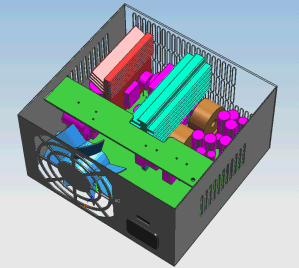
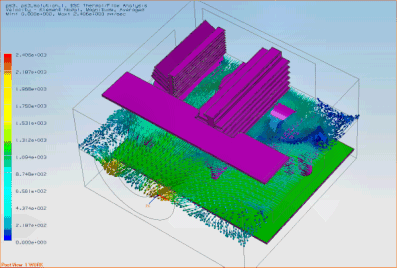
Aplicaciones de NX Electronic Systems
Cooling
 NX
Electronic Systems Cooling
helps resolve thermal engineering challenges early in the design process and is
a valuable aid in understanding the physics of fluid flow and heat transfer for
electronic enclosures and cooling applications.
NX
Electronic Systems Cooling
helps resolve thermal engineering challenges early in the design process and is
a valuable aid in understanding the physics of fluid flow and heat transfer for
electronic enclosures and cooling applications.
Some
practical applications
- Determining electronic systems cooling strategies
- Enclosure, subsystem and power supply thermal management
- Detailed thermal design of PC boards and multi-chip modules
- Thermally sensitive and critical components placement
- Heat sinks modeling
- Spacing requirements between critical parts
- Predicting fan operating conditions
- Volume and mass flow estimations
- Computing pressure inlet/outlet gradients and head losses
- Identifying recirculation areas and hot spot issues
- NX
Electronic Systems Cooling
has an interface with EDA design systems for direct and bi-directional PCB
and FPC data exchanges. All of the leading PCB and FPC layout software
packages are supported:
- Zuken
- Mentor Graphics
- Cadence
- VeriBest
- OrCAD
- Incases
- Comtel
Main
NX Electronic System Cooling features:
- Specific
capabilities for electronics simulation applications
- Heat sink models library and heat sink modeler
- Electronic thermal component library
- Fan catalogue (database of fan curves) with more than 2000 fans from leading manufacturers
- PCB modeler/xchange (ECAD/MCAD bi-directional data exchange)
- NX
Electronic Systems Cooling general simulation capabilities
- Steady-state and transient analysis (adaptive correction multigrid solver)
- Turbulent (k-εe, mixing length), laminar and mixed flows
- Internal or external flows
- Automatic skin mesh (boundary layer mesh) with unlimited layer options
- Complete set of automatic and/or manual meshing options for the selected fluid domains
- Unstructured fluid meshes (supports any combination of tetrahedral, brick, pyramid and wedge elements-linear and parbolic types)
- Multiple 1st and 2nd order advection with or without flux limiters
- Efficient time stepping and other algorithms for fast transient calculations
- Solution intermediate results recovery allowing solver restart
- Heat loads and temperature restraints on the fluid domain
- Forced, natural and mixed convection
- Fluid buoyancy
- Multiple enclosures
- Multiple fluids
- Losses in fluid flow due to screens, filters and other fluid obstructions (including orthotropic porous blockages)
- Head loss inlets and openings (fixed or proportional to calculated velocity or squared velocity)
- Fluid swirl at inlet and internal fans
- Fluid recirculation loop with head loss, heat loss, heat input/loss or fluid temperature change between unconnected fluid regions
- Automatic connection between disjoint fluid meshes
- Altitude effects
- Nonlinear flow boundary conditions
- Nonlinear thermal contacts
- Thermal couplings (welded, bolted, bonded, and other thermal contacts) for assembly modeling
- Disjoint thermal/fluid meshes support in assembly modeling
- Surface-to-surface radiative heat transfer
- Thermal solution customization (user subroutine)
- Hemicube-based view factor calculation (using graphics card hardware)
- Radiation enclosures
- Radiative sources
- Diurnal solar environmental heating (including cloud, altitude, longitude and latitude effects, pollution and other solar attenuation effects)
- Specular and transmissive surfaces
- Hydraulic fluid networks
- Joule heating
- Heater and thermostat modeling
- Peltier cooler modeling

SÍGUENOS
EN: 


